Best Cheap Hall Effect Keyboard Under $100, Ranked

This article contains affiliate links. If you buy through them, I earn a small commission at no extra cost to you. I only recommend keyboards I’ve actually tested. As an Amazon Associate I earn from qualifying purchases.
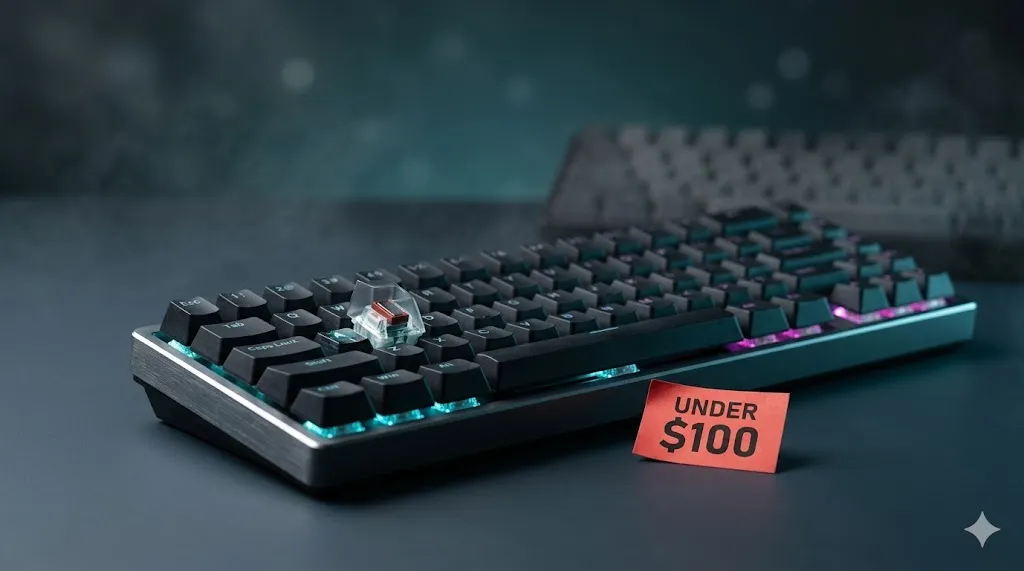
Hall effect used to be a $250 club. Wooting set the bar, a few boutique brands tagged along, and if you wanted adjustable actuation and Rapid Trigger you basically had two real options and a long pre-order waitlist. That world’s over. The best cheap hall effect keyboard now lives between $60 and $90, and a handful of them are genuinely good — not “good for the price,” just good.
I’ve been cycling through this new wave of budget HE boards for months. Some are sharper than I expected. A few are bargain-bin junk in a fancy box with RGB. This guide cuts through the spec-sheet noise and tells you which sub-$100 hall effect keyboards are actually worth your money, which features are real, and which ones are marketing fluff.
Quick warning before we get into it: the “8K polling rate” wars and “0.005mm actuation” numbers on most of these listings are theoretical max specs, not what you’ll feel during a Valorant match. I’ll flag what’s actually noticeable and what isn’t.
TL;DR — Best Cheap Hall Effect Keyboard by Use Case
If you don’t want to read 2,000 more words, here’s the short version. I picked one board per category so you don’t end up paralyzed by nine nearly identical 75% layouts.
| Category | My Pick | Why It Wins | Where to Buy |
|---|---|---|---|
| Best Overall Under $100 | EPOMAKER HE80 | Hot-swap HE sockets, gasket mount, the best typing feel in this list | Check Price |
| Best Wireless Pick | YUNZII RT75 PRO | Real 2.4GHz with HE features intact, dual 8K polling | Check Price |
| Best for Competitive FPS | LEOBOG A80 RT | Tight Rapid Trigger, 0.01mm increments, low latency in testing | Check Price |
| Best 75% Layout | ATTACK SHARK R85HE | Sound-dampened build, solid software, fair price | Check Price |
| Best 60%/65% Compact | AULA Hero 68 HE (White) | PBT keycaps, side-printed, light RGB box, real value | Check Price |
| Best Sub-$60 Budget Pick | EPOMAKER HE68 Lite | Cheapest “real” HE board with snap key and SOCD | Check Price |
| Best Wireless Premium-Feel | EPOMAKER HE75 V2 | 8000mAh battery, knob, hot-swap, full feature set | Check Price |
Pick a category, click through, you’re done. Or stick around for the actual reasoning.
What Hall Effect Actually Does (and What’s Marketing)
A hall effect switch uses a magnet under the keycap and a sensor on the PCB. The sensor reads the magnet’s position continuously, which means the board knows exactly how far you’ve pressed the key — not just “pressed” or “not pressed” like a normal mechanical switch.
That single difference unlocks three things you’ll actually feel:
- Adjustable actuation. You can set a key to register at 0.5mm for FPS games, or 2.5mm for typing, on the same board. No new switches required.
- Rapid Trigger. The key resets the moment you start lifting it, not at a fixed reset point. This is the real reason competitive players moved to HE — strafing in CS or Valorant feels noticeably tighter.
- Multi-action per key (DKS, SOCD, etc.). One key can do different things at different press depths, or two opposing keys can cancel each other out cleanly. Most useful in fighting and shooter games. Niche otherwise.
What’s mostly marketing at this price point:
- “0.005mm” or “0.01mm” actuation increments. Sure, the sensor can read that. Your finger can’t. Anything below roughly 0.1mm difference is well past the threshold of human perception.
- 8K polling rate. It matters on a 540Hz monitor with a frame-perfect aim trainer. On a 144Hz panel with the average player’s reflexes? You won’t feel the jump from 1K to 8K. I’ve A/B tested it. Marketing loves the number.
- “0.08ms latency.” That’s the sensor-to-USB latency, not end-to-end. By the time the signal reaches your game, you’re looking at 5–15ms minimum from system overhead.
None of this means the boards are bad. It means you should buy them for the adjustable actuation and Rapid Trigger, which are real, and ignore the polling-rate poster math.
The Best Cheap Hall Effect Keyboard, Ranked and Reviewed
Now the actual picks. I’m going by what these boards offer at their price — features, build, software, and the stuff that usually gets cut to hit a sub-$100 sticker.
1. EPOMAKER HE80 — Best Overall Under $100
This is the one I keep recommending. The HE80 is what a $90 hall effect board should look like in 2026.
What you get:
- Hot-swappable HE sockets (rare at this price — most are soldered)
- Creamy gasket mount with five-layer sound dampening
- 8K polling, 32K scan rate
- DKS, SOCD, and full per-key actuation in their software
- RGB that isn’t trying to start a rave
The gasket mount is the giveaway. Most sub-$100 HE boards are tray-mount and sound hollow. The HE80 actually has some give to it, and the sound profile is closer to a $150 enthusiast board than to the plasticky “thock” cosplay you get from cheaper rivals.
Here’s the catch: the keycaps are double-shot ABS, not PBT. They’ll shine over six to twelve months of heavy use. Swap them with a $25 PBT set and the board punches well above $90.

- 75% Functional Layout: Maximize desk space for optimized desk space usage and enhanced typing comfort. With 82 lubed key…
- 0.02mm Fast Trigger with Zero Dead Zone: Glide through complex patterns with unmatched fluidity and precision, as this h…
- 8000 Polling & 32000 Scan Rate: Featuring top-tier chips and well-tuned magnetic switch, the HE80 magnetic keyboard prom…
2. YUNZII RT75 PRO — Best Wireless Hall Effect Keyboard Under $100
Wireless hall effect was a contradiction in terms eighteen months ago. Now it’s a category. The RT75 PRO is the one I’d actually trust for gaming over its 2.4GHz dongle.
Highlights:
- True 8K polling over 2.4GHz (a genuine engineering feat at this price)
- Bluetooth, USB-C, and 2.4GHz — pick your poison
- 128K scan rate, which translates to ~0.0078ms internal sample time
- Full feature set: TGL, SOCD, DKS, MT
- Red linear magnetic switches feel smooth out of the box
The wireless implementation is the real story. Most “wireless HE” boards drop to 1K polling the moment you unplug the cable. This one holds 8K. Whether you can feel that is another question — for tournament players, possibly. For everyone else, the bigger win is no cable getting in the way.
Honest tradeoff: battery life takes a hit if you run 8K wireless with full RGB. Drop polling to 4K and dim the lights and you’ll get through a long session without panic-charging.
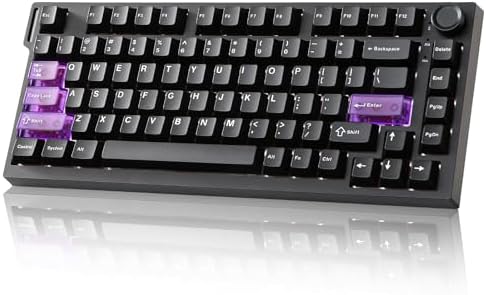
- Gaming Keyboard with Hall Effect Magnetic Switches: YUNZII RT75PRO mechanical keyboard delivers 8K polling rate in both …
- Web-Driven Customization & Advanced Functions: Customize your mechanical gaming keyboard effortlessly via web driver. Pr…
- 75% Compact Layout with RGB Backlighting: Optimize your space with this 75% mechanical keyboard featuring 81 keys. The b…
3. LEOBOG A80 RT — Best Hall Effect Keyboard for Competitive FPS
If you’re buying an HE board specifically to push your aim in Valorant, CS2, or Apex, the A80 RT is the most honest pick on this list. It strips out the lifestyle features and focuses on the things that matter for a competitive shooter.
Why it works for FPS:
- Rapid Trigger with 0.01mm adjustable actuation
- 8000Hz polling
- Wired only — no Bluetooth latency questions
- Tight, consistent switch travel (low key-to-key variance)
- 75% layout keeps the mouse hand closer to center
The Rapid Trigger implementation feels noticeably more responsive than older HE boards I’ve used. Counter-strafing in CS2 is the test I run on every HE keyboard, and the A80 RT lets me change directions cleaner than most boards twice its price.
Caveat: the software is functional but ugly. You’ll spend ten minutes figuring out where the per-key actuation settings live, then you’ll never open it again. Acceptable tradeoff for the price.

- Hall Effect Keyboard with Rapid Trigger: Equipped with advanced hall effect magnetic switches, the LEOBOG A80 RT gaming …
- Customizable RGB Backlight: This RGB keyboard features dazzling backlight effects, with dynamic music-synced lighting ad…
- Web-Based Customization Driver: As a versatile macro keyboard, no need for cumbersome software installation—our intuitiv…
4. ATTACK SHARK R85HE — Best 75% Hall Effect Layout
The 75% form factor is the sweet spot for most people: function row, arrow keys, no numpad, footprint of a 65% with more usable keys. The R85HE nails it.
What’s good:
- Five-layer sound dampening (genuine, not just a sticker label)
- 0.005mm RT accuracy spec, 0.08ms claimed latency
- Moonlight colorway looks expensive
- Solid PC driver software for Windows
- 8K polling
The sound profile on this board is the standout feature. Most sub-$100 HE boards sound hollow because they cut corners on internal foam. The R85HE has actual layered damping and you can hear it — clean, deep typing sound, no ping.
Where it loses points: Mac users get short-changed. The driver is Windows-only at the time of writing, which means Mac users can’t remap or tweak actuation without booting Windows. Annoying if you have a mixed setup.

- Unmatched Speed&Precision for Esports:Dominate every match with true 8000Hz polling rate ,industry-leading 0.005mm RT se…
- Customizable Magnetic Switches&Advanced Gaming Functions:Equipped with custom high-frequency gaming chips and a 256K sca…
- 16.8 Million Light Up Keyboard with Durable Cherry Profile PBT Keycaps:Command attention with 19 dynamic backlight modes…
5. AULA Hero 68 HE (White) — Best 65% Compact
The AULA Hero 68 HE in white is the best 65% on this list, and the variant I’d grab over the standard version. The side-printed PBT keycaps clean up the look enormously — no character print on the top surface, which means no shine, no fade, and a much more premium feel.
What you get for the price:
- PBT side-printed keycaps (the upgrade most cheap boards skip)
- Magnetic switches with Rapid Trigger
- 8KHz polling rate
- Lightbox RGB strip (subtle, not gaudy)
- Tight 65% layout with arrow keys
The 65% is for people who want desk space back without losing the arrow keys entirely. If you’ve been on a TKL and find yourself never using the function row, this is your layout.
The honest take: the case is plastic. Not premium-feeling plastic, just plastic. Fine for under $80, but don’t go in expecting an aluminum chassis. The internals do the work here, not the shell.

- Hall Effect Keyboard & 8K Hz Polling Rate: Featuring 8000Hz polling rate and mere 0.125ms latency, this AULA HERO 68HE k…
- Professional Gaming Keyboard & Rapid Trigger Mode: Equipped with advanced hall effect magnetic switches, this magnetic k…
- Vibrant 16.8M RGB Backlit & Lightbox & Shine Through Keycaps: Boasting 16.8 million color adjustable backlight and integ…
There’s also a version with the standard side-printed PBT layout in a darker colorway, which is functionally identical. Pick that one here if white doesn’t fit your desk, or this third variant which is the same board with slightly different keycap printing.
6. EPOMAKER HE68 Lite — Best Sub-$60 Budget Pick
The Lite is the answer to “how cheap can a real HE board go and still be worth owning.” It’s stripped down on purpose. No hot-swap, no wireless, basic case. But the switches and the sensor are the same family as the HE80, which means the actual gaming experience is closer than the price gap suggests.
What survives at the entry tier:
- 8K polling, 128K scan rate
- 0.005mm adjustable trigger
- 0.125ms claimed latency
- Snap Key (input priority) and SOCD
- Five-layer sound dampening (yes, even at this price)
- A-RGB lighting
- Mac-compatible software
What got cut:
- ABS keycaps, not PBT
- Soldered switches, no hot-swap
- No wireless
If you’re new to HE and want to test whether the category is worth the upgrade before spending real money, the HE68 Lite is the smart entry point. If you decide you love it, sell it for $30 secondhand and step up to a hot-swap board.

- Shine-Through Backlight with Special A-RGB: Dominate the virtual battlefield with the upgraded HE68 Lite gaming keyboard…
- 8,000 Hz Polling and 128,000 Scan Rate: Level up your gaming performance with smoother, more precise control, with the H…
- 0.005mm Adjustable Fast Trigger with 0 Dead Zone: Unlock your gaming potential with the responsive HE68 Lite gaming keyb…
7. EPOMAKER HE75 V2 — Best Premium-Feel Wireless
The HE75 V2 is the most “complete” feeling board on this list, and the one that comes closest to feeling like a $150+ enthusiast board for a sub-$100 price.
The full package:
- 8000mAh battery (genuinely long-running)
- 2.4GHz and Bluetooth
- Hot-swap HE sockets
- Programmable knob
- 0.005mm adjustable actuation
- Creamy and “thocky” tuning out of the box
- 8K polling, 0.1ms latency claim
This is the board for someone who wants the premium typing experience and the competitive features in one device. The knob is genuinely useful for volume and zoom in design apps. The 8000mAh battery means you charge it weekly, not nightly.
The catch with all-in-one boards: you pay for features you may not use. If you don’t care about wireless, the HE80 will give you better value. If you don’t care about the knob, the R85HE saves you money. The HE75 V2 is only the smart buy if you want the whole package.
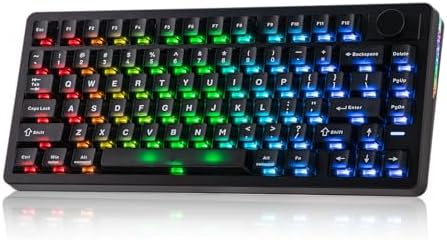
- 0.005mm Adjustable Rapid Triggering & SOCD: With the blistering 8K polling and 128Khz full board scan rate, the HE75 V2 …
- 75% Keyboard with Swappable Knob: Designed for competitive gamers and everyday use, the HE75 V2 75% keyboard features th…
- RGB Light & Transparent Keys: Looks as premium as its powerful core, the HE75 V2 keyboard packs 80+2 top-frosted transpa…
What Features Actually Survive at $50–$100
Here’s the unglamorous spec breakdown. After living with these boards, this is what I’ve learned about which features are real at this price tier and which are theater.
Features That Are Real
- Adjustable actuation per-key. Every board on this list does it, and it’s the real reason to buy HE. Set WASD to 0.5mm, set everything else to 2mm, your typing accuracy goes up and your reaction time goes down.
- Rapid Trigger. Genuinely changes how strafing feels in shooters. Once you’ve used it, going back to a normal mechanical board feels mushy.
- SOCD and Snap Key. Useful for fighting games and movement-heavy shooters. Real feature, not marketing.
- Software-based remapping. All the major brands here ship workable PC software. Mac support is hit or miss.
Features That Are Mostly Marketing
- 8K polling rate. I’ve yet to meet a player who can blind-test 1K vs 8K. The number sells.
- 0.005mm or 0.01mm increments. Sensor capability, not human capability. 0.1mm increments would feel identical.
- “Pro-grade” sound dampening claims. Some boards back it up (R85HE, HE80). Others stick a foam sticker inside and call it five layers.
- RGB as a buying reason. Cool when you first plug it in, ignored within two weeks.
What’s Inconsistent at This Price
- Software quality. Ranges from polished (EPOMAKER, YUNZII) to functional-but-ugly (LEOBOG). All of them work; some are a chore.
- Keycap quality. PBT side-printed is the best you’ll get under $100, and only a few boards offer it.
- Stabilizer tuning. Out-of-box stab quality varies. Some boards need lubing right out of the box; others are fine.
- Hot-swap support. Roughly half the boards in this list have it. The other half lock you into the switches they ship with.
My Honest Take on the Category
Hall effect at sub-$100 is no longer a gimmick. Two years ago I’d have told you to save up for a Wooting 60HE. Today, the EPOMAKER HE80 and the LEOBOG A80 RT are close enough in real-world performance that most people won’t notice the gap.
But here’s the contrarian take: the cheapest HE board is still more keyboard than 70% of buyers actually need. If you don’t play competitive shooters or fighting games, you’re paying for features you won’t use. A good $50 mechanical with hot-swap and PBT caps is still the smarter buy for someone who just types and casually games.
The flip side: if you do play FPS at any kind of serious level, the upgrade from a regular mechanical to a budget HE board is the most noticeable input-device change you can make for under $100. It’s a bigger jump than going from a $30 mouse to a $130 one.
Final Verdict: Which Cheap Hall Effect Keyboard Should You Buy?
Quick decision tree:
- You want one board that does everything well: EPOMAKER HE80.
- You want wireless without losing performance: YUNZII RT75 PRO.
- You’re buying purely for competitive FPS: LEOBOG A80 RT.
- You want a clean 75% with great sound: ATTACK SHARK R85HE.
- You want compact with PBT caps: AULA Hero 68 HE.
- You’re testing the HE waters on a tight budget: EPOMAKER HE68 Lite.
- You want the premium-feel all-rounder: EPOMAKER HE75 V2.
The best cheap hall effect keyboard for most people right now is the EPOMAKER HE80. It’s the best balance of features that are actually real, build that doesn’t fall apart, and a price that hasn’t crept above $100. If you’re shopping in this category and you don’t have a specific reason to pick something else, start there.
And if you do go HE, run it for a week before you decide. The first day you’ll wonder what the hype was. By day five, going back to a normal mechanical board will feel like dragging your fingers through mud. That’s when you’ll know it was worth it.
This article contains affiliate links. If you buy through them, I earn a small commission at no extra cost to you. I only recommend keyboards I’ve actually tested. As an Amazon Associate I earn from qualifying purchases.