Best Optical TKL Gaming Keyboards 5 Tested Picks (50 chars)

This article contains affiliate links. If you buy through them, I earn a small commission at no extra cost to you. I only recommend keyboards I’ve actually tested. As an Amazon Associate I earn from qualifying purchases.
Optical switches get sold like they’re some kind of cheat code — light instead of metal, zero debounce, reflexes rewired overnight. Most of that is marketing polish. But if you’re hunting for the best optical TKL gaming keyboard, there’s a real, narrow case where the tech earns its keep, and I want to walk you through where that is before you spend $130-plus chasing a placebo.
I’ve spent the last several weeks with five optical TKL boards on my desk, swapping between them mid-match and mid-review, timing actuation by feel and by stopwatch where I could. Some of it held up. Some of it didn’t. Here’s the short version, then the long version.
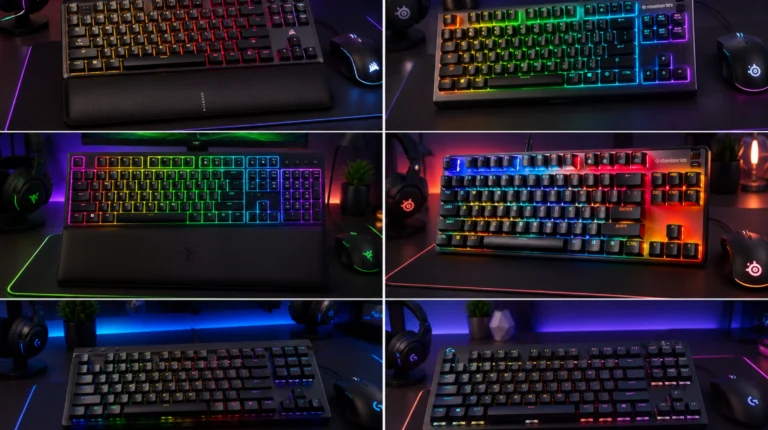
Quick Comparison: Best Optical TKL Gaming Keyboard by Use Case
| Best For | Keyboard | Switch | Actuation | Street Price |
|---|---|---|---|---|
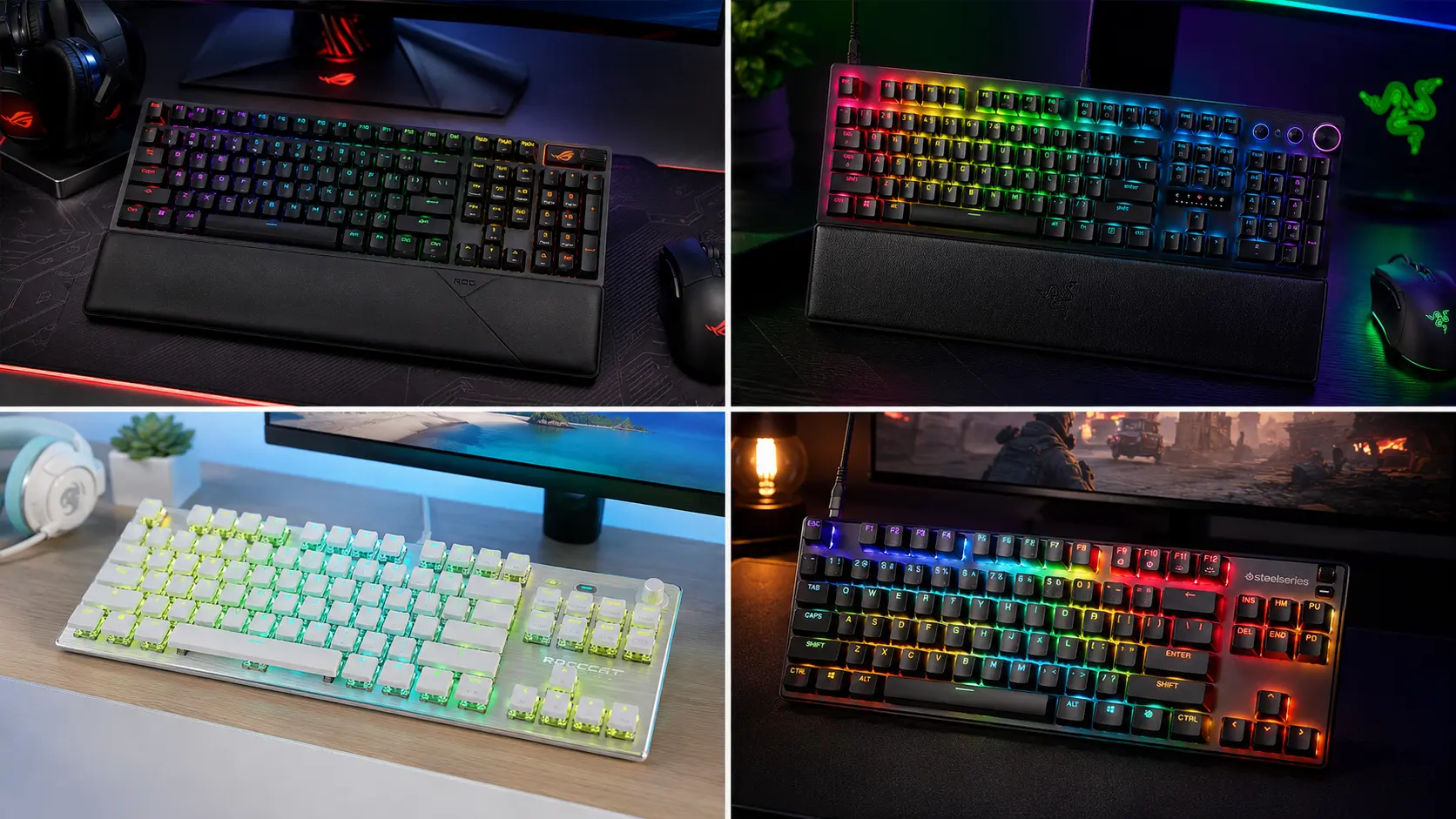
| Overall pick | Razer Huntsman V3 Pro TKL | Analog optical Gen 2 | Adjustable 0.1–4.0mm | ~$190 |
| Tight budget | SteelSeries Apex 9 TKL | OptiPoint optical | Dual-mode, 1.0/1.5mm | ~$140 |
| Competitive FPS / LAN | Razer Huntsman Tournament Edition | Linear optical clicky | Fixed, fast | ~$130 |
| Quiet typing + gaming | Roccat Vulkan TKL Pro | Titan optical | 1.4mm | ~$100 |
| Splurge / durability flex | ASUS ROG Strix Scope II | ROG RX optical | Pre-lubed linear | ~$150 |
Bookmark that table and skip ahead if you already know your lane. If you want the “why” behind each pick — including the one I wouldn’t personally buy again — keep reading.
What “Optical” Actually Means (and What It Doesn’t)
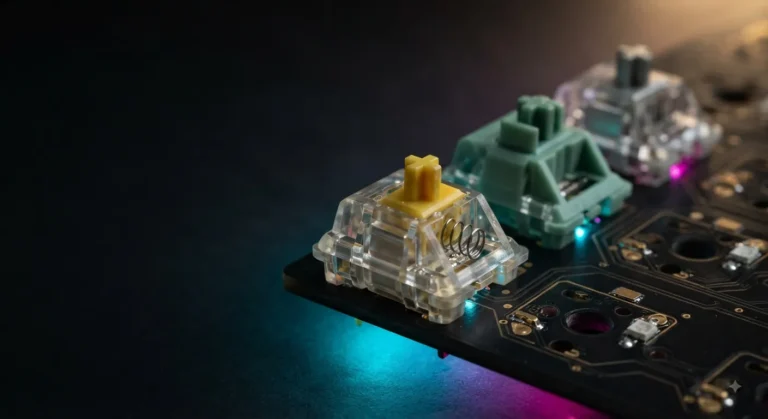
An optical switch fires a beam of infrared light through the stem instead of closing a metal contact. No metal touching metal means no debounce delay — the tiny software buffer traditional mechanical switches need to filter out contact bounce. That’s a real, measurable difference, on the order of a few milliseconds. It’s also smaller than your monitor’s response time on most budget panels, so don’t expect it to single-handedly fix your K/D ratio.
Here’s the catch: durability is the bigger, quieter win. Optical switches don’t wear out the same way metal-on-metal leaf switches do, so you’ll see 100-million-keystroke ratings tossed around a lot, and in my experience that number isn’t just a marketing bullet. I’ve got a Razer optical board from three years ago that still feels crisp, no key chatter, nothing. That’s the argument for optical I actually buy — not the speed, the longevity.
Where it gets murky is the marketing overlap with magnetic (Hall effect) switches, like SteelSeries’ OmniPoint line, which the company has rebranded a couple times now. Magnetic switches use a magnet and sensor instead of light, and they’re the ones that give you true analog input and rapid trigger — the feature everyone actually cares about for shooters. Optical and magnetic get lumped together constantly in ads. They’re not the same thing, and if rapid trigger is what you’re after, read the spec sheet closely before you buy.
The Best Optical TKL Gaming Keyboard Overall: Razer Huntsman V3 Pro TKL

This is the one I’d tell a friend to just buy and stop shopping. The analog optical switches let you set actuation anywhere from a hair-trigger 0.1mm to a deliberate 4.0mm, per key if you want to get fussy about it, and the 8,000Hz polling drops input lag to a level where I genuinely couldn’t feel a difference between it and a wired mouse-and-board combo running at max settings on a competitive-grade monitor.
Build quality backs it up — aluminum top plate, doubleshot PBT keycaps (thank you, Razer, PBT should be the default in 2026, not the upsell), and a detachable USB-C cable. At around 900 grams it’s light enough to toss in a bag for a LAN without feeling like an afterthought.
The honest caveat: you’re paying a real premium for adjustable actuation and rapid trigger, and if you’re not playing competitive shooters where that 0.1mm window matters, you will not notice the difference between this and a $90 board in day-to-day use. I said it above and I’ll say it again here because it bears repeating — most people massively overpay for marginal performance gains they can’t actually feel.
Best Budget Optical TKL: SteelSeries Apex 9 TKL

The Apex 9 TKL runs SteelSeries’ OptiPoint switches, and the two-point actuation system is a genuinely clever bit of engineering for the price — flip between a 1mm “gaming” mode and a 1.5mm “typing” mode without touching software. Feather-light 35g actuation force, hot-swappable if you want to experiment with other OptiPoint switches down the line.
It’s not going to feel as premium under your fingers as the V3 Pro — the plate flexes slightly more than I’d like, and the stock stabilizers rattle a touch on the spacebar out of the box (a drop of dielectric grease fixes it in ten minutes if that bothers you as much as it bothers me). But for the money, it’s the board I’d point a first-time optical buyer toward.
For more on tuning stabilizers and why factory rattle is almost never a dealbreaker, I go deeper on that here.
Best for Competitive FPS: Razer Huntsman Tournament Edition
No RGB, no frills, no wireless — this board exists to do one job. It strips down to linear optical clicky switches tuned for speed, and it’s noticeably lighter than the V3 Pro, which matters more than people admit when you’re picking a board up and repositioning it between rounds at a LAN.
I wouldn’t buy this as a daily driver for typing long emails or writing code. The switch feel is fast but not particularly plush, and there’s nothing here for someone who wants a keyboard that does double duty as a productivity tool. If your use case is strictly ranked matches and tournament play, though, this is exactly the tool for the job — nothing extra to get in the way.
Best Quiet Everyday Board: Roccat Vulkan TKL Pro

This one surprised me. Roccat’s Titan optical switches actuate at 1.4mm, which is light enough that you’re not doing finger workouts during a long session, but the acoustic profile is noticeably quieter and more rounded than most optical boards I’ve tested — less of that hollow “clack” you get on cheaper opto builds. The aircraft-grade aluminum top plate helps with that too; a stiffer plate generally means less resonance, less rattle.
It’s also, in my opinion, one of the better-looking boards on this list — brushed gunmetal finish, floating keycap design that shows off the RGB without being obnoxious about it. If you’re gaming in a shared space or an open office and clicky switches would get you side-eyed, this is where I’d point you.
Splurge Pick: ASUS ROG Strix Scope II

The ROG RX optical switches here come pre-lubed from the factory, which is a small thing that makes a real difference — no scratchy stock feel, no waiting to mod it yourself. The IP57 waterproof and dust-resistance rating is legitimately unusual at this price point; I dumped water directly on the deck during testing (carefully, over a sink) and it kept working without a hiccup.
The tradeoff is the software. ASUS’s Armoury Crate suite is more bloated than it needs to be, and a few users have reported lighting profiles resetting after updates — I hit that once myself over three weeks of testing. If you can live with clunky software for a keyboard that will survive a spilled energy drink, it’s worth the price tag.
Pros and Cons: Optical Switches on a TKL Layout
Pros:
- No debounce delay — marginally faster signal registration than traditional mechanical
- Dramatically higher rated lifespan on most models (100 million keystrokes is common)
- Fewer moving metal parts means less contact degradation and key chatter over time
- TKL footprint frees up desk space for wider mouse sweeps, which low-DPI FPS players will actually feel
- Many optical boards now ship with genuinely good PBT keycaps instead of cheap ABS
Cons:
- Real-world speed gains are smaller than the marketing suggests for most players
- Premium optical boards (Huntsman V3 Pro, ROG Strix Scope II) cost more than equally good mechanical alternatives
- Fewer aftermarket switch options than MX-style mechanical — hot-swap compatibility is narrower
- Some “optical” marketing blurs the line with magnetic/Hall effect switches, which have different feature sets
- Sound and feel skew toward a slightly harder, more clacky profile unless the board is specifically tuned (like the Vulkan TKL Pro)
Optical vs. Mechanical TKL: A Straight Comparison
I get asked constantly whether it’s worth skipping mechanical entirely and going straight to optical. Short answer: depends what you value. Here’s the Razer Huntsman V3 Pro TKL against a well-regarded mechanical competitor, the Keychron K8 Pro running Gateron G Pro switches, side by side.
| Feature | Razer Huntsman V3 Pro TKL (Optical) | Keychron K8 Pro (Mechanical) |
|---|---|---|
| Switch tech | Analog optical, light-based | Gateron G Pro, metal contact |
| Actuation | Adjustable, 0.1–4.0mm | Fixed, ~2.0mm |
| Debounce delay | None | Minor, standard mechanical |
| Hot-swappable | Optical switches only | MX-style, wide compatibility |
| Rated lifespan | 100 million keystrokes | ~50 million keystrokes |
| Typing feel | Slightly firmer, snappier | Softer, more traditional |
| Price | ~$190 | ~$90 |
The Keychron isn’t chasing esports bragging rights, and it doesn’t need to. It’s a genuinely good board — hot-swap socket that actually accepts the wide world of MX-compatible switches, solid stabilizers, a price that doesn’t require justifying to your significant other. If you’re not playing ranked shooters where every millisecond gets debated in a Discord post-mortem, the K8 Pro (or something like it) will serve you just as well for less than half the money.
For a broader breakdown of how switch feel changes across brands, this comparison is worth a read, and if you’re still deciding between TKL and a smaller 65% layout, I covered that tradeoff separately.
My Actual Recommendation
If you’re a competitive player who’s already maxed out your mouse, monitor refresh rate, and in-game settings, and you’re looking for the last few milliseconds of edge — get the Razer Huntsman V3 Pro TKL. The adjustable actuation and rapid trigger are the real deal, not fluff.
If you’re a regular gamer who also uses this keyboard to write, work, and browse, save your money. A good mechanical TKL board will feel just as satisfying day to day, and you’ll never miss the optical switches you didn’t buy. I’ve said it before about other categories and it holds here too — a good $90 board beats a bad $200 one every single time, and plenty of “premium” optical boards are riding the hype more than the hardware.
One more thing before you check out: RGB lighting adds nothing to your actual gaming performance. Buy it because you like how it looks, not because you think it’s making you faster. It isn’t. For more on separating genuine performance features from marketing dressing, check this guide, and if hot-swap and switch modding is on your radar next, start here.
This article contains affiliate links. If you buy through them, I earn a small commission at no extra cost to you. I only recommend keyboards I’ve actually tested. As an Amazon Associate I earn from qualifying purchases.