Best Budget Keyboard Switches Under $0.30 (5 Tested Picks)

This article contains affiliate links. If you buy through them, I earn a small commission at no extra cost to you. I only recommend keyboards I’ve actually tested. As an Amazon Associate I earn from qualifying purchases.
I’ve had a running argument with people online for years about switch prices. The premium crowd swears you can’t get a good typing feel under $0.50, and the ultra-budget crowd insists a $0.10 Outemu is “basically the same.” Both are wrong. The best budget keyboard switches sit in the middle, and honestly, it’s a great time to shop for them.
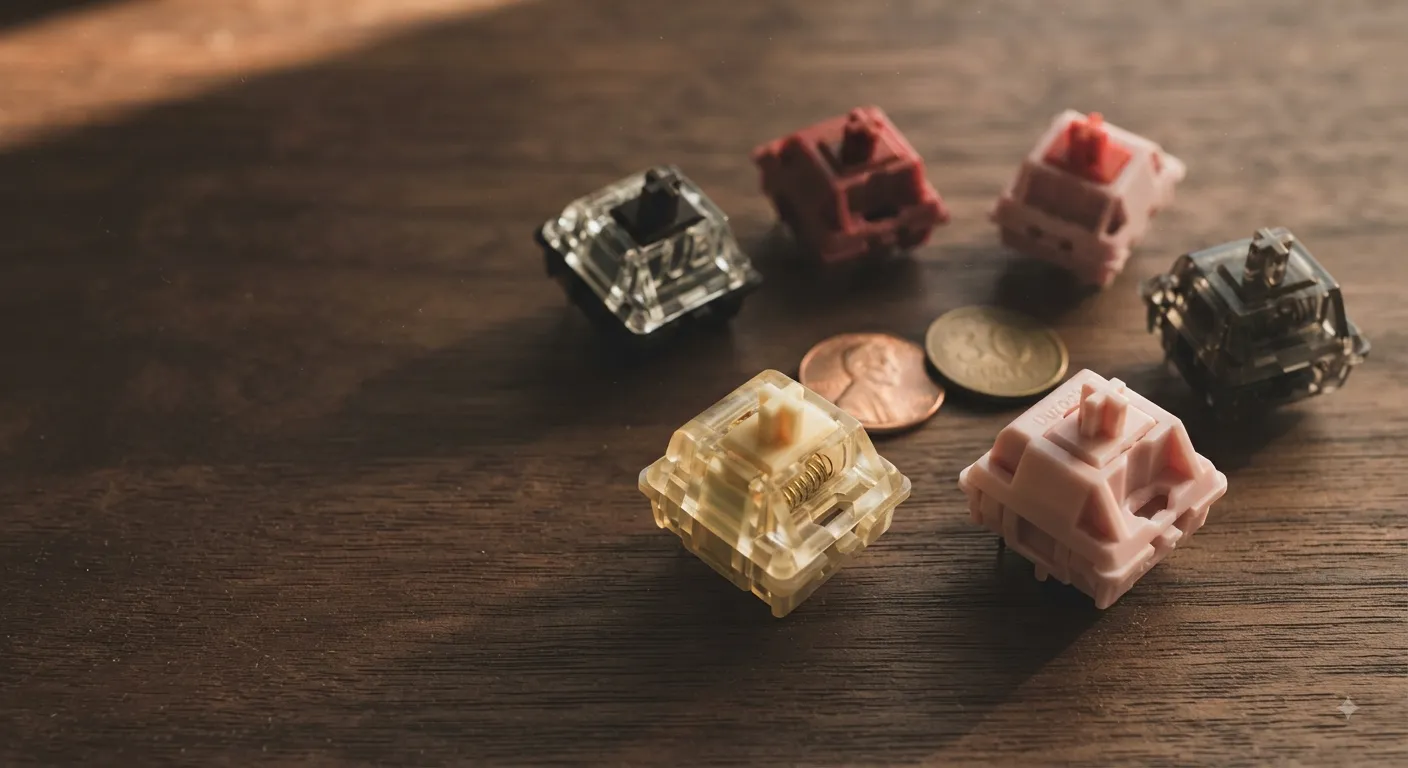
Competition from Gateron, Akko, KTT, and Outemu has pushed the floor for genuinely usable switches down to about $0.20–$0.30 each. That means you can knock out a full 87-key TKL build for roughly $20–$25 in switches — a number that felt impossible when Cherry MX Reds were still the default at $0.50+.
Below is my current shortlist. I’ve typed on every one of these for at least a few weeks. I’ll tell you what they’re for, what they aren’t, and where each one starts to show its price tag.
Quick Comparison Table: The TL;DR
Here’s the fast version if you’re already scrolling for the winner. Pick the row that matches your situation and click through.
| Category | Switch | Type | Actuation | Best For | Approx. Price |
|---|---|---|---|---|---|
| Best Overall | Gateron Milky Yellow | Linear | 50g | Smooth, deep sound cheap | ~$0.28 |
| Best for Gaming | Akko CS Jelly Pink | Linear | 45g | Fast, light presses in FPS/MOBA | ~$0.22 |
| Best Sound Profile | KTT Strawberry | Linear | 43g | Enthusiast “thock” on a budget | ~$0.25 |
| Best Heavy Linear | Akko CS Jelly Black | Linear | 50g | Typists who bottom out hard | ~$0.22 |
| Cheapest Usable | Outemu Red | Linear | 45g | Ultra-tight budgets, first builds | ~$0.18 |
Prices vary by vendor and pack size. Bulk 90–110 packs from KBDfans, Divinikey, Kinetic Labs, or KPRepublic are usually the sweet spot per unit.
What to Look for in the Best Budget Keyboard Switches
Three things worth saying before we get into individual picks.
- Factory lube is huge under 30 cents. A dry $0.20 switch feels like sandpaper on a hot day. A lightly lubed $0.25 switch can pass for something twice the price. That single difference decides most of this list.
- Housing plastic matters — but not the way marketing says. POM, PC, and nylon all have real sonic differences, but scratchiness comes from mold quality and lube, not the letters on the datasheet.
- You’ll live without hair-splitting spec numbers. Anyone claiming to feel the difference between a 43g and a 45g spring in normal typing is bluffing. Save that debate for when you’re spending real money.
If you want a deeper primer on switch anatomy and how all this actually plays out in a build, I’ve got a longer guide to mechanical switch types that pairs well with this list.
1. Gateron Milky Yellow — Best Overall Budget Linear
If you asked me to hand one switch to a friend building their first custom, this is it. The Gateron Milky Yellow (also sold as KS-3 Milky) is the switch that broke the market. It came in around $0.25, typed as smooth as switches costing three times as much, and pretty much every “budget king” list since has been trying to dethrone it. None have.
The nylon housings give it the deep, muted, creamy sound people chase. The 50g bottom-out is a comfortable middle ground — light enough for gaming, heavy enough that you don’t accidentally trigger keys with a resting finger. Factory lube out of the pack is light but real. Drop them in a foam-modded board with PBT caps and you’ve got something that genuinely sounds and feels premium.
Pros
- Smoothest stock feel in the sub-$0.30 tier
- Deep, muted sound that pairs with almost any keycap set
- Widely available, easy to hot-swap into any MX board
- Consistent quality control across batches in my testing
Cons
- The 50g spring feels heavy if you’re used to red switches
- Spring ping is more common than on premium switches (a drop of lube fixes it)

- Gateron G Ks-3 milky yellow Pro V2 switch is Pre-lubed will feel better than regular milky yellow.
- Alloy contacts process upgrade, The improve the resistance to oxidation and vulcanization, Thus improving the service li…
- Yellow: Linear – 50g Actuation Force, Lifetime: 80 million cycles.
Pair these with a decent budget hot-swap keyboard and you’ve got a build that punches way above what you paid.
2. Akko CS Jelly Pink — Best for Gaming
I ran the Akko CS Jelly Pink as my primary gaming board for about three weeks last spring. For fast-paced FPS games — Valorant, CS2, Apex — they’re a serious sleeper pick. The 45g actuation is light enough to double-tap quickly without the mushy feel of ultra-light 35g switches, and Akko’s dustproof stem design keeps stem wobble low, which matters when you’re spamming inputs.
Where they lose points is typing sound. Compared to the Milky Yellow, they’re a bit brighter, a touch more plasticky, and the stock feel is drier than Gaterons. Not bad — just clearly a step below. For a gaming board where you don’t care as much about acoustics, that’s a fine trade at this price.
Pros
- Excellent stem stability for the price
- Light 45g weight suits fast gaming inputs
- Polycarbonate bottom housing plays nicely with RGB
- 60-million-keystroke rated lifespan
Cons
- Drier stock feel than Gaterons — lubing helps a lot
- Not as deep-sounding as nylon-based competitors

- Akko CS Switch Series – The new line of Akko Custom Series (CS) switches comes with dustproof stem to reduce stem wobble…
- Jelly Pink 45gf Linear Switch – With an actuation force of 45gf, Akko Jelly Pink is a great middle-of-the-road option fo…
- Built-in LED Slot – Akko CS switches are equipped with LED slot ready for LED Mod/Assembly, and are SMD compatible (LED …
3. KTT Strawberry — Best Sound Profile
Here’s where I turn on my own budget crowd a little. Most sub-$0.30 switches sound fine. The KTT Strawberry sounds good. Different bar.
The combination of PC top, nylon bottom on the V2, and POM stem gives Strawberries a marbley, thocky sound that shows up especially well in tape-modded boards. They’re smoother than they have any right to be at this price, and the 43g spring is on the light side — some typists love that, others find it twitchy.
Honest caveat: KTT batches vary. My first pack was silk-smooth. A second pack from a different vendor had one or two scratchy stems in the mix. Buy from a reputable vendor and this rarely bites you, but it’s worth knowing.
Pros
- Deep, “thocky” sound that punches above the price
- Light, factory-lubed feel out of the pack
- Fantastic pair with tape-mod and foam-mod builds
Cons
- Batch consistency isn’t perfect
- The 43g spring may feel too light for heavy typists
- POM stem picks up more lube residue than average

- KTT Strawberry V2 linear switches, one of the most popular and smoothest linear switches from KTT, they feel as good as …
- Upgrade: The biggest change in V2 has been the reduction in the number of runners in the injection molding process. Decr…
- Excellent mold: The switches come with POM stem, PC top housing & Nylon bottom housing for an extreme durable purpose PC…
If you’re going down the sound rabbit hole, my writeup on common keyboard sound mods explains what pairs well with these.
4. Akko CS Jelly Black — Best Heavy Linear
The Akko CS Jelly Black is the switch I recommend when someone tells me they keep triggering keys with a resting palm or a knuckle. At 50g actuation with a slightly stiffer spring than the Milky Yellow, it takes a bit more intention to press.
They share the Jelly Pink’s dustproof stem and PC bottom, so RGB looks great and stem wobble is minimal. The sound is on the clackier side compared to Gaterons — brighter, snappier, a bit less deep. If you like a crisp typing sound instead of a muted one, that’s actually a feature, not a bug.
Pros
- Heavier weight prevents accidental keypresses
- Snappy, clacky sound signature
- Consistent stem tolerances batch to batch
Cons
- Not the smoothest of the bunch stock; a light lube helps
- The heavier spring will tire your pinkies if you type at 100+ WPM for hours

- Akko CS Switch Series – The new line of Akko Custom Series (CS) switches comes with dustproof stem to reduce stem wobble…
- Jelly Black 50gf Linear Switch – Jelly Black is the heaviest Akko CS switches with 50gf actuation force and a 22mm exten…
- Built-in LED Slot – Akko CS switches are equipped with LED slot ready for LED Mod/Assembly, and are SMD compatible (LED …
These pair particularly well if you’re already running one of my recommended keyboards for programmers — the extra weight suits long typing sessions where you don’t want to fat-finger.
5. Outemu Red — Cheapest Usable Option
I’ll take heat for including this, but hear me out. If you’re building your first mechanical, outfitting a work board you don’t care about, or testing a new hot-swap PCB before you commit to premium switches, the Outemu Red is the honest answer.
At around $0.15–$0.18 per switch depending on the vendor, it’s about as cheap as a genuine linear gets. It’s not as smooth as a Gateron Yellow. There’s more spring ping. The sound is thinner. But it works, it lasts, and it’s a real linear — not a mushy budget-brand knockoff pretending to be one.
Just know what you’re getting: this is the “gets the job done” pick, not the “you’ll fall in love” pick. If you’ve got another $10–$15 in the budget, jump straight to the Gateron Milky Yellow instead. If you don’t, this won’t embarrass you.
Pros
- Cheapest genuinely usable linear on this list
- Available almost everywhere Outemu is stocked
- Easy to hot-swap and try before spending real money
Cons
- Noticeably less smooth than Gateron and KTT options
- More spring ping and a pingy top-out
- Housings feel slightly cheaper on close inspection
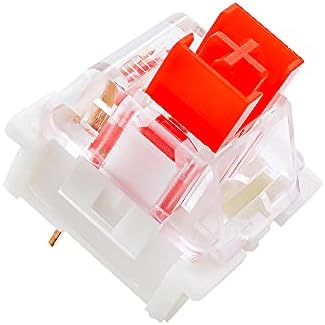
- Compatibility:Replacement Switches for Standard MX Mechanical Keyboards,including Redragon,E-yooso, Huo ji and More . OU…
- Smooth & Linear Keypresses: Experience a fluid, uninterrupted typing motion with no tactile bump or audible click. Outem…
- User’s Preference:Perfect for those who prioritize fast, silent inputs over tactile feedback. These switches cater to ga…
How to Pick the Right Budget Switch
If you made it this far and you’re still on the fence, here’s the short version I’d give a friend at a bar.
- You mostly game and want speed. Akko CS Jelly Pink or Gateron Milky Yellow.
- You mostly type or write for hours. Gateron Milky Yellow for smoothness, or Akko CS Jelly Black if you want more resistance.
- You care about sound above all else. KTT Strawberry, ideally with a tape mod and PBT caps.
- You want the safest all-rounder. Gateron Milky Yellow, no notes.
- You have $15 total and a first mech to build. Outemu Red.
One contrarian take, since I promised one: most people at this budget waste more money on RGB and fancy cases than they ever “waste” on the switches themselves. A $65 board with Milky Yellows, PBT caps, and a piece of neoprene under the plate will out-type a $150 gaming board with stock switches nine times out of ten. Fix the stabilizers and the switches first; worry about the aluminum case later.
The Bottom Line
The best budget keyboard switches aren’t a compromise anymore. They’re just switches. Buy any of the five above from a reputable vendor and you’re getting something a serious enthusiast would happily use as a daily driver.
My default recommendation stays the Gateron Milky Yellow for most people, with the KTT Strawberry as the pick if you care about sound above everything else. If you want to squeeze more out of whichever you choose, my full keyboard modding guide walks through the tape, foam, and lube tweaks that turn a decent budget board into something you’ll genuinely enjoy typing on. Then take the money you saved on switches and put it into better keycaps. That’s the biggest upgrade you’re not thinking about.
This article contains affiliate links. If you buy through them, I earn a small commission at no extra cost to you. I only recommend keyboards I’ve actually tested. As an Amazon Associate I earn from qualifying purchases.