Double-Shot vs Dye-Sub Keycaps: Legend Printing Methods

This article contains affiliate links. If you buy through them, I earn a small commission at no extra cost to you. I only recommend keyboards I’ve actually tested. As an Amazon Associate I earn from qualifying purchases.
Pull a 2017 GMK set off one of my old boards and a 2019 Drop MT3 set off another, and you know what you’ll find? Both still look brand new. That’s the boring truth most articles about double shot vs dye sub skip right past — at the quality tier you should actually be buying at, both methods will outlast the board they’re sitting on. The legends aren’t going anywhere.
So the real question isn’t durability. It’s what each method lets a manufacturer print, what plastic you’re stuck with, and whether your RGB is going to shine through cleanly. After about fourteen years of lubing, modding, and reviewing keyboards — and a small drawer full of dead prototypes I’m weirdly proud of — I’ve typed on enough of both to have strong opinions. Here’s what you actually need to know before you drop $130 on a keycap set.
Quick Comparison: Which Keycap Type Wins for You?
If you scroll past the rest of this article, at least take this with you. It’s the cheat sheet I’d hand a friend.
| Your Priority | Winner | Why It Wins |
|---|---|---|
| 🎮 Best for RGB & backlighting | Double-shot | Translucent legends let light through cleanly |
| 🎨 Best for bold artwork & gradients | Dye-sub | Print detail is wild — almost no design limits |
| 💸 Best on a $40–$80 budget | Dye-sub PBT | Akko, EPBT-style sets give you premium feel cheap |
| ♾️ Longest legend lifespan | Double-shot | The legend is the cap — impossible to physically wear off |
| 🔊 Best typing sound (“thock”) | Either, in PBT | The plastic matters way more than the print method |
| ✨ Most premium “designer” sets | Double-shot ABS (GMK) | The community standard for group buys |
| ⚪ Best for white legends on dark caps | Double-shot | Standard dye-sub can’t print light on dark |
| 👆 Best textured, premium feel | Dye-sub PBT | Texture and depth feel noticeably better than smooth ABS |
That’s the TL;DR. If you stopped reading right now, you’d already know more than most buyers walking into a keyboard purchase. But let’s get into why each method works the way it does — because once you understand it, picking sets gets a whole lot easier.
What “Double-Shot” Actually Means
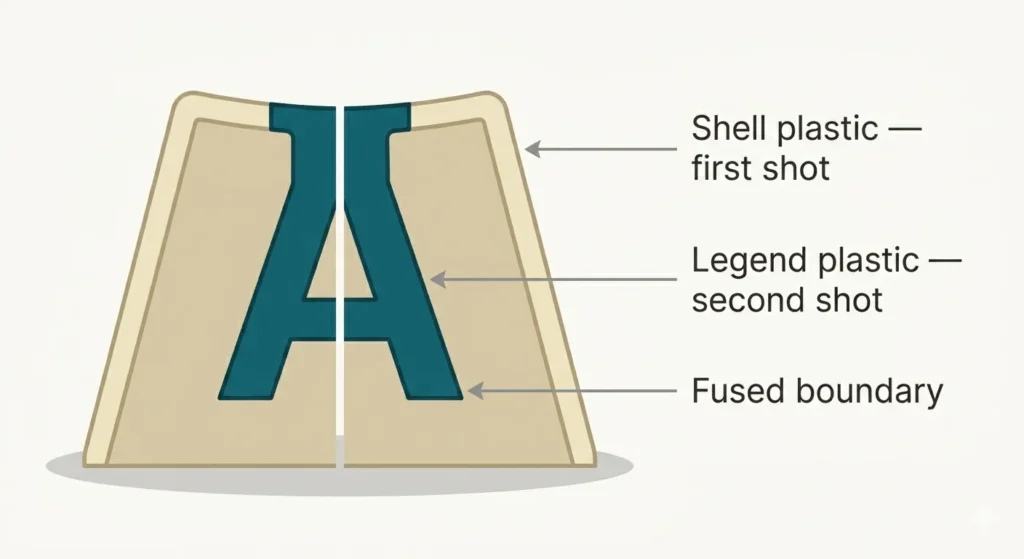
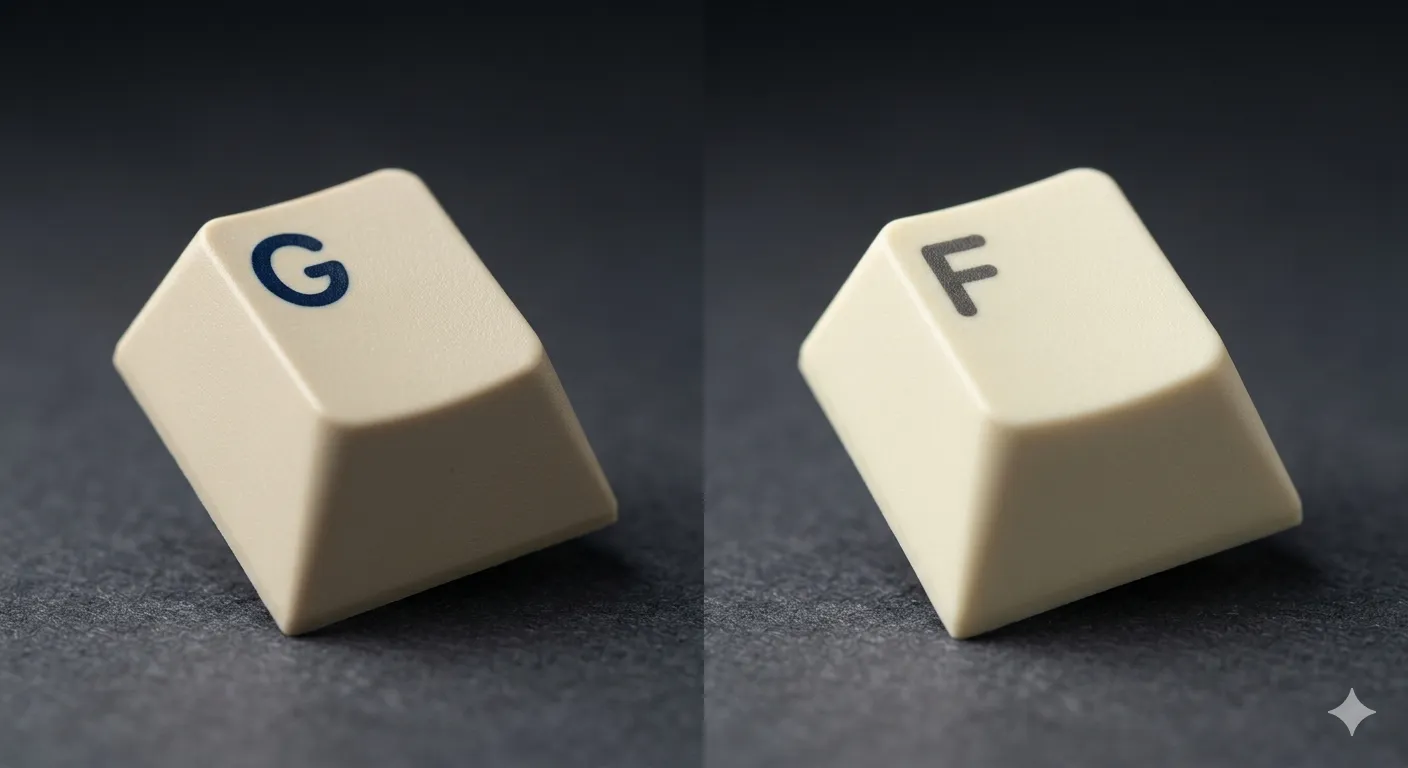
Double-shot is a manufacturing process, not a material. The cap is molded from two separate shots of plastic in two stages:
- First shot: the “shell” of the keycap is molded with the legend area as a hollow cutout.
- Second shot: a different-colored plastic is injected to fill that cutout — that’s your legend.
- Result: a single fused cap where the legend runs all the way through the plastic.
You couldn’t sand the letters off if you tried. I’ve actually tested this with a beat-up GMK keycap and some 400-grit sandpaper — you’ll wear the cap face down to a different shape long before the legend ever disappears.
Here’s the catch: double-shot molds are expensive, the alignment has to be near-perfect, and every legend variation needs its own tooling. That’s why double-shot sets cost more, and why most of the premium “designer” colorways (GMK, ePBT in their double-shot runs) live in the $130–$200 range.
Common Double-Shot Keycap Brands
- GMK — German manufacturer, Cherry profile, ABS double-shot. The community gold standard.
- ePBT — Korean-made PBT double-shot. Premium feel, great colors, group-buy heavy.
- Tai-Hao — Affordable double-shot ABS in stock colors. Solid budget option.
- Signature Plastics (SA, DSA) — Tall sculpted profiles, double-shot ABS classics.
What “Dye-Sublimation” Actually Means
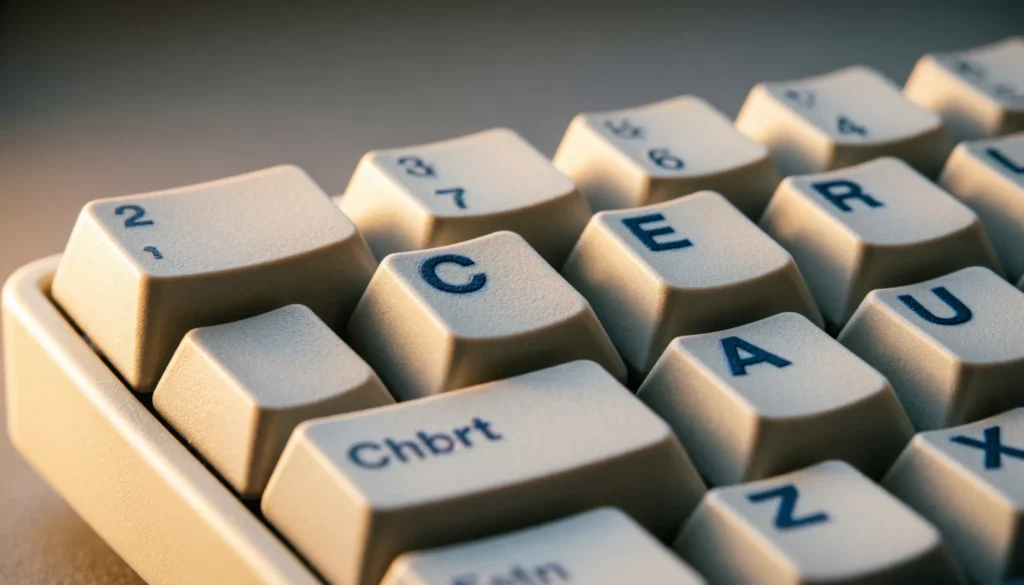
Dye-sub uses heat and pressure to push dye gas into the plastic itself. The dye bonds with the polymer below the surface — it’s not paint sitting on top of the cap. With a printed-then-coated keycap, you can usually feel the legend (a slight bump or change in gloss). With dye-sub, the cap surface is completely uniform. Smooth PBT all the way across.
It’s the same process used on athletic jerseys and coffee mugs. For keycaps, it’s almost always done on PBT, because PBT accepts dye cleanly and ABS doesn’t.
Here’s the catch: dye-sub can only print darker than the cap base color. Dye doesn’t lighten anything; it only adds pigment. So if you want a black cap with white legends — the single most common keyboard look on the planet — that’s not coming out of a standard dye-sub line. You’d need “reverse dye-sub,” which is a different and finicky process. This is why most dye-sub sets you see have light-colored caps with dark legends, or playful multi-color designs with intentionally limited palettes.
Common Dye-Sub Keycap Brands
- Drop MT3 — Deep dish profile, dye-sub PBT, fantastic artwork on themed sets.
- EnjoyPBT — Dye-sub PBT in Cherry profile, often in vintage or pastel themes.
- Akko — Affordable dye-sub PBT, available everywhere on Amazon and direct.
- KBDfans / KAT / KAM profiles — Sculpted dye-sub PBT for sound and feel snobs.
Double Shot vs Dye Sub: Head-to-Head Comparison
| Feature | Double-Shot | Dye-Sub |
|---|---|---|
| Common plastic | ABS (sometimes PBT) | Almost always PBT |
| Legend durability | Effectively permanent | Excellent; theoretically fades after years of UV |
| Design freedom | Limited (1–2 solid colors per cap) | Massive (gradients, photo-realistic art, full novelties) |
| Backlight shine-through | Yes, easily | No (legends are opaque) |
| Light legends on dark caps | Easy | Not without reverse dye-sub |
| Typical price range | $90–$200+ | $30–$130 |
| Most common profiles | Cherry, OEM | Cherry, OEM, MT3, KAT, KAM, MOA |
| Sound profile | Brighter (ABS), deeper (PBT runs) | Deeper, drier “thock” (PBT) |
Durability: Honestly, It’s a Tie at the Top
A take that’s going to annoy some enthusiasts: at quality-tier brands, neither method “wears out” in any realistic timeframe. I’ve got dye-sub sets I’ve been pounding daily for five-plus years and the legends are still crisp. The myth that dye-sub fades fast comes from cheap, low-quality printers — not the method itself.
Where things actually get ugly is with pad-printed keycaps, the third option people often lump in by mistake. Pad printing is the budget method on stock Razer, Logitech, and Corsair boards. Those legends will shine, fade, and rub off in 18 months of normal use. The double shot vs dye sub debate is a tier above all that. Pad print is where you should actually worry.
Sound and Feel: The Plastic Matters More Than the Print
A lot of buyers assume double-shot ABS sounds different from dye-sub PBT. It does — but not because of the printing method. It’s because of the plastic underneath.
- ABS is thinner (around 1.2mm walls), smoother, and develops a “shine” on heavily used keys after months of typing. It sounds slightly higher-pitched and brighter. Some people call it “creamy.”
- PBT is thicker (typically 1.4–1.5mm), more textured, and almost never develops shine. It sounds deeper and drier — the “thock” everyone keeps tweeting about.
So when someone says “dye-sub sounds better,” they’re really saying PBT sounds better than ABS — at least to their ear. That’s a totally fair preference. Just don’t credit the print method for it.
RGB and Backlighting: Double-Shot Wins, No Contest
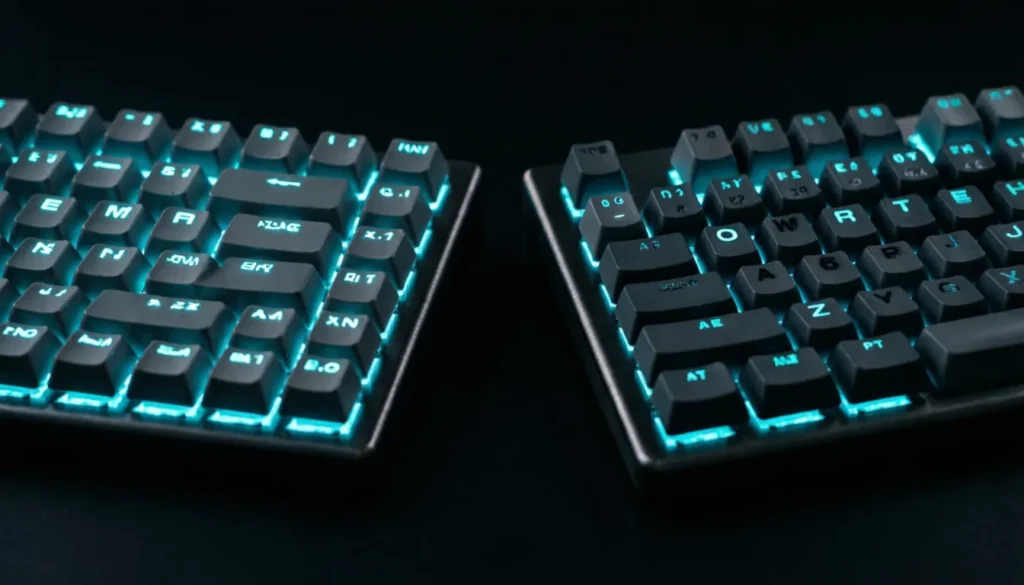
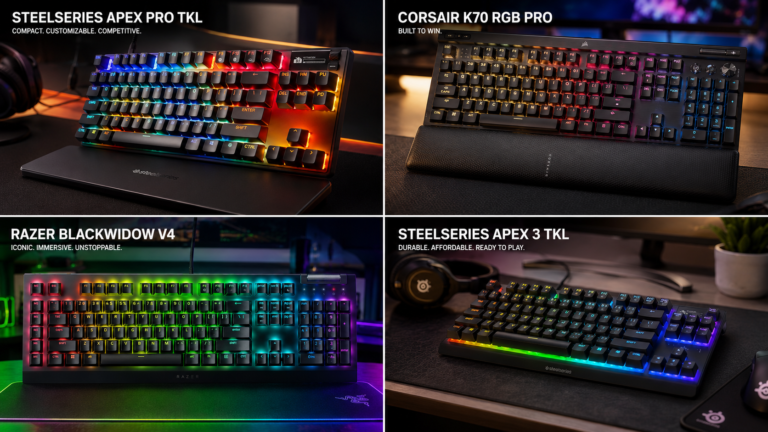
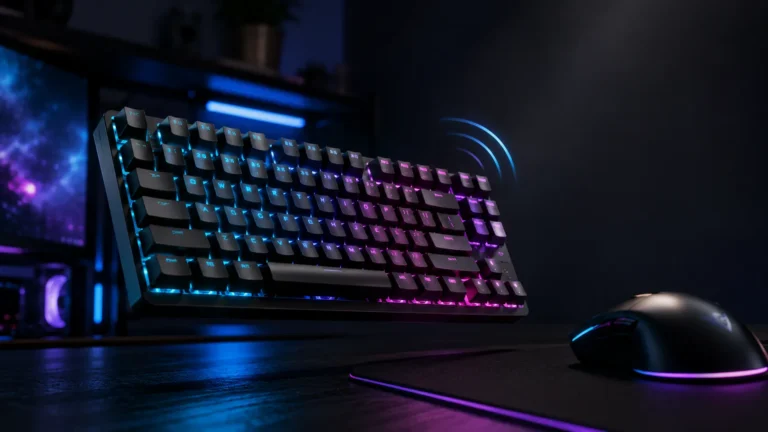
If you bought your board for the RGB, this is the section that matters. Double-shot lets the manufacturer use a clear or translucent plastic for the legend itself — when the LED hits it, the letter lights up cleanly. Dye-sub caps are solid pigment all the way down. Light won’t shine through the letters, period. You’ll still get glow around the edges of the cap, but the legend itself stays dark.
For enthusiast typists, this doesn’t really matter. For someone gaming in a dark room who wants WASD lit up like a runway, it absolutely does.
Price and Value: Dye-Sub Stretches Your Dollar
A rough breakdown of where your money actually goes:
- $30–$60: Solid dye-sub PBT sets from Akko, generic EPBT-style sellers, Keychron stock caps.
- $60–$90: Better dye-sub PBT, deeper color options, sculpted profiles like MT3 and KAT.
- $90–$130: Where double-shot starts to make sense — Tai-Hao, lower-tier double-shot Cherry profile, ePBT.
- $130–$200+: Premium GMK group-buys and similar designer sets. Mostly double-shot ABS Cherry profile.
If you’re building your first nice setup, an $80 dye-sub set on a $120 board will beat a $200 double-shot set on a $50 board every time. I really believe that. The board matters more than the keycap printing method.
So Which Should You Actually Buy?
Quick verdicts based on what’s sitting on my desk right now:
- You want a set that’ll look new in 10 years: Double-shot ABS or PBT.
- You want the best-looking keyboard you can afford: Dye-sub PBT in a sculpted profile.
- You want bright RGB shining through your letters: Double-shot shine-through, no debate.
- You want premium feel without waiting six months for a group buy: Dye-sub PBT in MT3, KAT, or Cherry profile, in stock today.
- You just want a great-typing board and you’ll move on with your life: A $50 Akko dye-sub set is going to make you very happy.
Honestly? Most people overthink keycaps. Get a quality set in a profile and color you like, and stop reading forum threads.
FAQ: Double Shot vs Dye Sub Keycaps
Are dye-sub keycaps worse than double-shot?
No. They’re different, not worse. At quality tiers, both will outlast your keyboard. Dye-sub gives you better design freedom and a more textured feel; double-shot gives you shine-through capability and is the standard for premium designer sets.
Do double-shot keycaps last longer than dye-sub?
Marginally. Double-shot legends are physically part of the cap and can’t wear off. Quality dye-sub legends can theoretically fade after many years of heavy UV exposure, but in real-world use across boards I’ve owned for half a decade, I’ve never actually seen it happen on a good set.
Why are GMK keycaps always double-shot ABS?
GMK uses precise German-engineered double-shot molds and Cherry profile tooling that’s been in service for decades. They’ve stuck with ABS because their process is dialed in for it. The trade-off is that ABS develops shine on heavily used keys — most users won’t notice it for at least a year.
Can dye-sub keycaps shine through with RGB?
Generally no. The pigment is opaque all the way through. A handful of experimental sets use workarounds with translucent bases, but you should assume “no shine-through” when you’re buying dye-sub.
Is PBT always dye-sub and ABS always double-shot?
No, but it’s the common pairing. PBT can absolutely be double-shot (ePBT, some GMK runs), and ABS can technically be dye-sub (rare, and the quality suffers). When most people argue double shot vs dye sub, they really mean double-shot ABS vs dye-sub PBT.
Why can’t dye-sub print white legends on black caps?
Dye-sublimation only adds pigment — it can’t remove or lighten color. You can dye a light cap darker, but not a dark cap lighter. Reverse dye-sub exists but it’s expensive, slow, and rarely used outside of small custom runs.
Are double-shot keycaps worth the extra money?
If you want shine-through RGB or you’re invested in a specific designer colorway like GMK Olivia or GMK Laser, yes. For everyday typing on a reasonable budget, a $70–$90 dye-sub PBT set delivers about 90% of the experience for half the price. That’s where I’d tell most people to start.
What’s the difference between dye-sub and pad printing?
Big one. Pad printing sits paint on top of the cap; dye-sub fuses dye into the cap. Pad-printed legends rub off in a year or two of normal use — it’s what you’ll find on most off-the-shelf “gaming” keyboards under $80. If a keycap’s legend feels even slightly raised or glossy compared to the rest of the cap, it’s pad print, and you should treat it as disposable.
This article contains affiliate links. If you buy through them, I earn a small commission at no extra cost to you. I only recommend keyboards I’ve actually tested. As an Amazon Associate I earn from qualifying purchases.